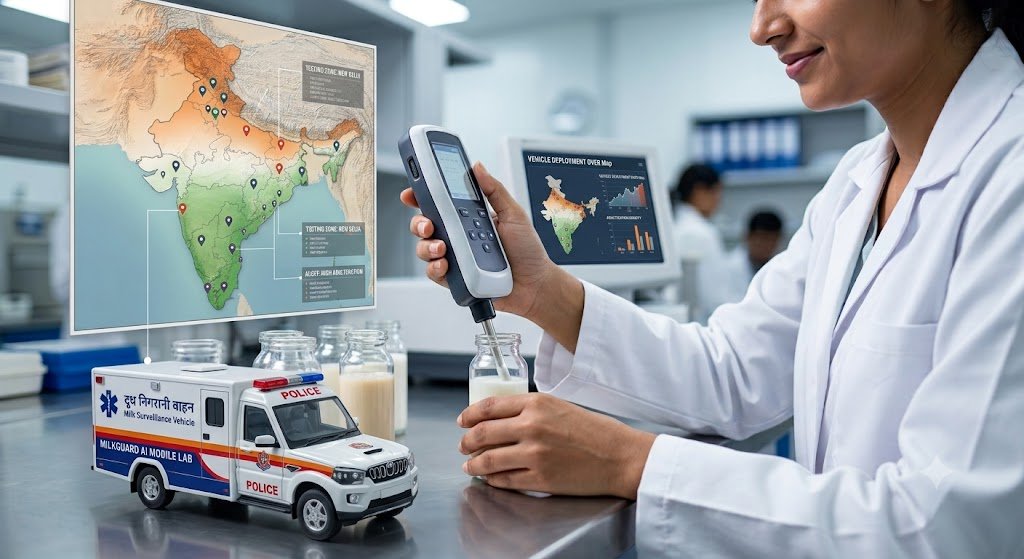
What Is FSSAI Doing About Milk Adulteration? Tracking Regulatory Actions with "MilkGuard AI"
You can explore the live dashboard here: MilkGuard AI
( this is an AI-Powered Digital Tool Developed by Dr. Tina)
Why this is important ?
Milk is one of the most widely consumed foods in Indian households and one of the most frequently adulterated. Year after year, FSSAI (Food Safety and Standards Authority of India) sampling drives uncover milk mixed with water, detergent, starch, urea, or even synthetic substitutes designed to mimic milk's taste and texture without any real nutritional value.
Why This Keeps Happening?
A few structural reasons make milk especially vulnerable to adulteration in India:
A long, fragmented supply chain. Milk often passes through multiple hands from individual farmers to local collectors to vendors , before reaching a consumer. Each handoff is a point where adulteration can occur, and traceability breaks down quickly outside branded, packaged supply chains.
Thin testing coverage. Food Safety on Wheels (FSW) vans are the mobile testing infrastructure meant to catch problems close to where milk is sold. But the ratio of vans to population and milk volume varies enormously by state , some regions have dense coverage, others have only a handful of vans for tens of millions of people.
Detection difficulty. Some adulterants (like water dilution) are relatively easy to spot with basic tools. Others ; formalin, certain synthetic additives are invisible to taste, smell, and casual inspection, and require lab testing to catch.
The Real Cost
Adulterated milk isn't just a quality issue , it's a health one. Diluted milk shortchanges nutrition, especially for growing children. Detergent and formalin exposure carry direct toxicity risks. Long-term, low-level exposure to some adulterants is linked to gastrointestinal and organ stress, and children, the elderly, and pregnant women are consistently the most vulnerable groups.
Where MilkGuard AI Fits In?
We built MilkGuard AI to make sense of the FSSAI enforcement data that already exists but is hard for an ordinary consumer to use spread across yearly reports, buried in dense tables, disconnected from the surveillance context that actually explains what the numbers mean.
The app does three things:
Surveillance Dashboard - shows how thin or dense FSW van coverage is per state relative to population and milk production, so you can see where testing capacity is genuinely stretched.
FSSAI Risk Analysis - combines non-conforming rates, unsafe sample rates, and enforcement severity (criminal cases, not just lab flags) into a single risk score per state, and tracks how that risk is trending year over year.
Consumer Alert - lets you check your own state's latest risk status in plain language, with an explicit warning whenever a "low risk" reading is based on too few samples to actually trust , because low testing volume is not the same thing as safe milk.
Why This Matters?
A single non-conforming statistic can't tell you whether your state's milk supply is actually safe or simply under-tested. MilkGuard AI is built to hold both pieces of information together what's been found, and how much looking actually happened so consumers get a more honest picture than a red-yellow-green label alone can provide.
With Love,
Dr. Teena ,Ph.D. in Human Health Risk
Project Researcher @The University of Tokyo


Leave a Thought